
Value Chain Management
Sustainable Supply Chain
With the UN's advocacy and worldwide trend in supply chain management, suppliers are expected to meet environmental, social, and governance standards in addition to quality, delivery, and cost to create sustainable value with partners across the value chain.

USI’s Supplier ESG Programs are executed and overseen by the Strategy and Sustainability Committee, led by the Chair under authorization from the Board of Directors. This structure ensures Board-level supervision, alignment of company policies and implementation, and continuous improvement to achieve long-term goals. In addition, the Sustainability Committee also track and review the performance of supply chain sustainability indicators on a semi-annual basis.
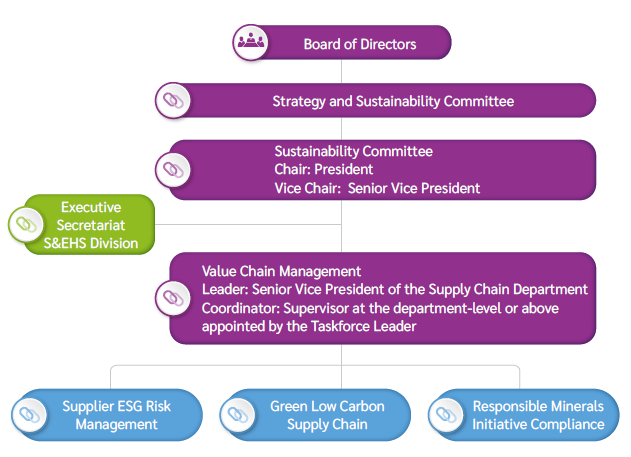
We conduct regular evaluations of our suppliers and invite selected partners to participate in our quarterly Executive Business Review meetings based on performance results. Using a scorecard approach, suppliers are assessed across four key dimensions: pricing, delivery and responsiveness, quality, and ESG. These meetings serve as a platform to communicate our sustainability policies and ESG strategies, exchange market insights, and share best practices.
In 2025 we trained our internal procurement staff and other employees in sustainability knowledge and awareness, with a total of 3,556 employees participating 2,654 hours in the training sessions, to ensure that they understand the Company's Supplier ESG Program and instill ESG principles and knowledge into each employee's role and implement their daily operations. USI are committed to driving sustainability improvements throughout the supply chain to reduce overall risk.
In response to the global transition toward net zero and evolving carbon management requirements, USI regards building a low-carbon supply chain as a key business strategy. By analyzing carbon emission hotspots across the supply chain, USI identifies priority areas for emissions reduction and encourages suppliers to establish greenhouse gas inventory, verification, and carbon management mechanisms, thereby enhancing the transparency and management of carbon-related information.
Through initiatives such as the CDP Supply Chain Program, climate-related questionnaires, and capacity-building activities, USI also supports suppliers in strengthening climate risk management and advancing emissions reduction actions. By working closely with its suppliers, USI aims to build a resilient, low-carbon supply chain and progress toward its net-zero emissions goal.
Low-Carbon Supply Chain Management Policy:
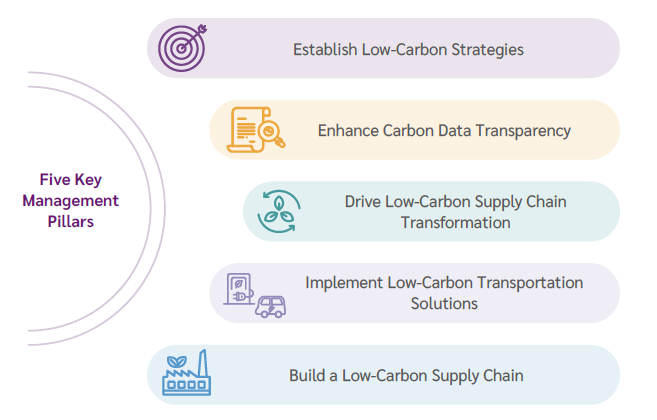
- Driving Low-Carbon Supply Chain Transformation
USI actively collaborates with equipment suppliers to advance the low-carbon transition. Through energy-efficient equipment design, energy management, and performance optimization, USI improves equipment energy efficiency and reduces carbon emissions. USI incorporates energy-saving requirements into its equipment development and management processes and encourages suppliers to jointly pursue technological innovation and improvement initiatives in energy conservation. These efforts continuously enhance operational efficiency and contribute to building a low-carbon supply chain characterized by resilience and sustainable competitiveness.
To properly assess the sustainability risk of suppliers and ensure they comply with USI's Supplier Code of Conduct, USI suppliers are required to sign a commitment to follow the Code and respond to USI's Sustainability Assessment Questionnaire (SAQ), which covers five aspects: labor rights, health and safety, environmental protection, sustainability and risk management, and supply chain management. These supplier risk assessments ensure their risks can be effectively reduced and controlled. On-site audits are conducted for suppliers that may have higher risks to gain a deeper understanding of their sustainability development status, implement effective supplier management, reduce risks, improve the overall efficiency of the supply chain, and strengthen the sustainable development of the supply chain.
Sustainability Risk Assessment Process:

Before conducting risk assessment of suppliers, USI must first proactively conduct supplier screening. The company selects suppliers to be included in control by annual procurement amount and identifies suppliers with potentially high risks in terms of governance, environment and social as the basis for key management.
Supplier Screening:
| Methodology for Suppliers Screening | |||
|
We proactively review and investigate all suppliers' countries/regions, their production processes, and their respective product categories to conduct preliminary assessments of suppliers and analyze potential risks.
|
|||
|---|---|---|---|
| Aspects of Suppliers Screening | |||
| Environmental | Social | Governance | Business Relevance |
|
|
|
|
To enhance overall supply chain competitiveness and ensure suppliers fulfill their corporate social responsibilities, we conduct written evaluations and on-site audits/inspections of suppliers through the SAQ. A survey of 495 unique suppliers was conducted in 2025, with a recovery rate of 76%. The evaluation results over the years are shown in the table below. We analyzed suppliers' SAQ responses, reviewed and assessed high-risk suppliers, and initiated audits. In 2025, we conducted on-site/document audits for 69 raw material suppliers. For deficiencies found during the audits, suppliers are required to submit improvement plans and must implement them within a specific timeframe, and the audit results were classified as low-risk. No supplier relationships were terminated.
Supplier Sustainability Risk Assessment:
| Year | Unit | 2022 | 2023 | 2024 | 2025 |
|---|---|---|---|---|---|
| Number of suppliers evaluated with sustainability metrics | - | 525 | 456 | 469 | 495 |
|
Percentage of suppliers that completed Supplier Sustainability Assessment Questionnaire
|
% | 73 | 76 | 76 | 76 |
| Number of suppliers on-site audited with sustainability metrics | - | 46 | 65 | 67 | 69 |
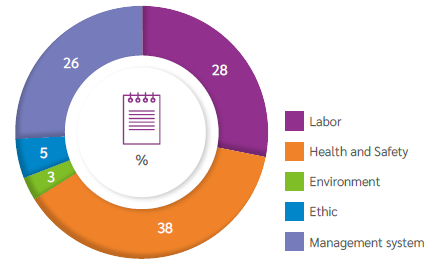
We analyzed the deficiency items in supplier audits and found that of the five major areas, 38% were health and safety. The detailed results are shown in the chart below. USI continues to support and guide suppliers in strengthening their sustainability management capabilities, working together to drive continuous improvement and sustainable development across the supply chain.
Distribution of Supplier and Contractors Sustainability Audit Findings:
USI conducts supplier human rights risk assessments to understand the importance of human rights issues in the supply chain. The results of suppliers found that "Human Rights Policy and Commitment, Non-Discrimination/Non-Harassment/Humane Treatment, Occupational Health and Safety, and Industrial Hygiene" as the main human rights risk issues. We also identified high-risk suppliers and took corresponding measures to continuously track the effectiveness of their corrective actions. Please refer to the details of Supplier Human Rights Incident Mitigation and Remediation Measures.

USI considers suppliers as key partners and attaches great importance to communication and interaction with them. Through supplier education and training, presentations, and technical/competency counseling, USI empowers suppliers to develop an awareness of sustainability management to meet the ever-changing trends and enhance the overall sustainability of the supply chain.
- Sustainable Supply Chain Training
- Supporting Suppliers with Improvement Actions
- Supplier Carbon Mentoring Program
- CDP Supply Chain Program