
USI Blog
Top trending topic for the latest innovation technology, application and industry insight.
Search
- 10/27/2026
A New Test Solution for HI Bottleneck: MicroPython Moves SiP from Being Tested to Testing Itself
Author: Callon Huang, Associate Manager of SX ATE Product Engineering Dept.
As Moore’s Law slows, system-in-package (SiP) technology, which integrates processors, memory, power management and RF components into a single module, has become key to making wearables and earbuds smaller and more capable. Yole Group projects that the global SiP market will grow from US$21.2 billion in 2022 to US$33.8 billion in 2028, with mobile and consumer electronics accounting for about 90% of it.
But more functions mean longer tests. Take a flagship true wireless stereo (TWS) earbud audio project that USI works on: the new-generation main controller chip delivers stronger active noise cancellation and spatial audio, and the test pins on the device under test (DUT) increased from 50 to 70, adding test items and test time. On a mass-production line, test time directly determines how many testers are needed. Every extra second, multiplied by high shipment volumes, adds up to significant cost. The customer and USI therefore set a joint goal: cut per-unit test time by 60 seconds without compromising stability.
The Conventional Bottleneck: A Passive Examinee
Conventional test software has three layers: the host handles the user interface, scheduling and data upload; the Mix Layer drives instruments such as source measure units (SMUs) and oscilloscopes; and at the bottom sits the firmware (FW) inside the DUT.
In this architecture, the DUT is like an examinee who can only answer when asked. Whenever an operating mode must be switched or a parameter set, the host has to send commands one by one over an interface such as UART, wait for the DUT to reply and confirm the result before directing the instruments to take the next measurement. A complete test involves about 3,000 commands, each taking 2–3 ms per round trip. The back-and-forth alone consumes a great deal of time, and the more communication hops there are, the higher the risk of errors.
What Is uPy? Turning a Passive DUT into a Self-Tester
uPy, short for MicroPython, is a lean implementation of Python 3 built for microcontroller units (MCUs). The industry uses it mainly for prototyping automotive, medical, IoT and wearable products, typically on platforms such as STM32 and ESP32, but usually as standalone firmware that does not work with other programs.
USI’s approach embeds uPy in the SiP product itself and runs it alongside the existing FW. The steps with the most frequent host–DUT interaction, procedurally tedious but computationally simple, are written in uPy, packaged into a binary (.bin) file and programmed into spare flash memory in the DUT. The FW needs only a few added commands, such as “start” and “stop.” At test time, a single command from the host is enough: the DUT sets its own modes, triggers instrument measurements, processes the data and returns all the results at once.
In other words, the examinee no longer waits for the teacher to read out each question; it receives the whole exam paper and works through it alone. This also frees the host: while the DUT executes Task A, the host can process Task B in parallel, and Task C begins once both are done. Based on our industry benchmarking, this is the first time MicroPython has worked in concert with FW in a SiP test system.
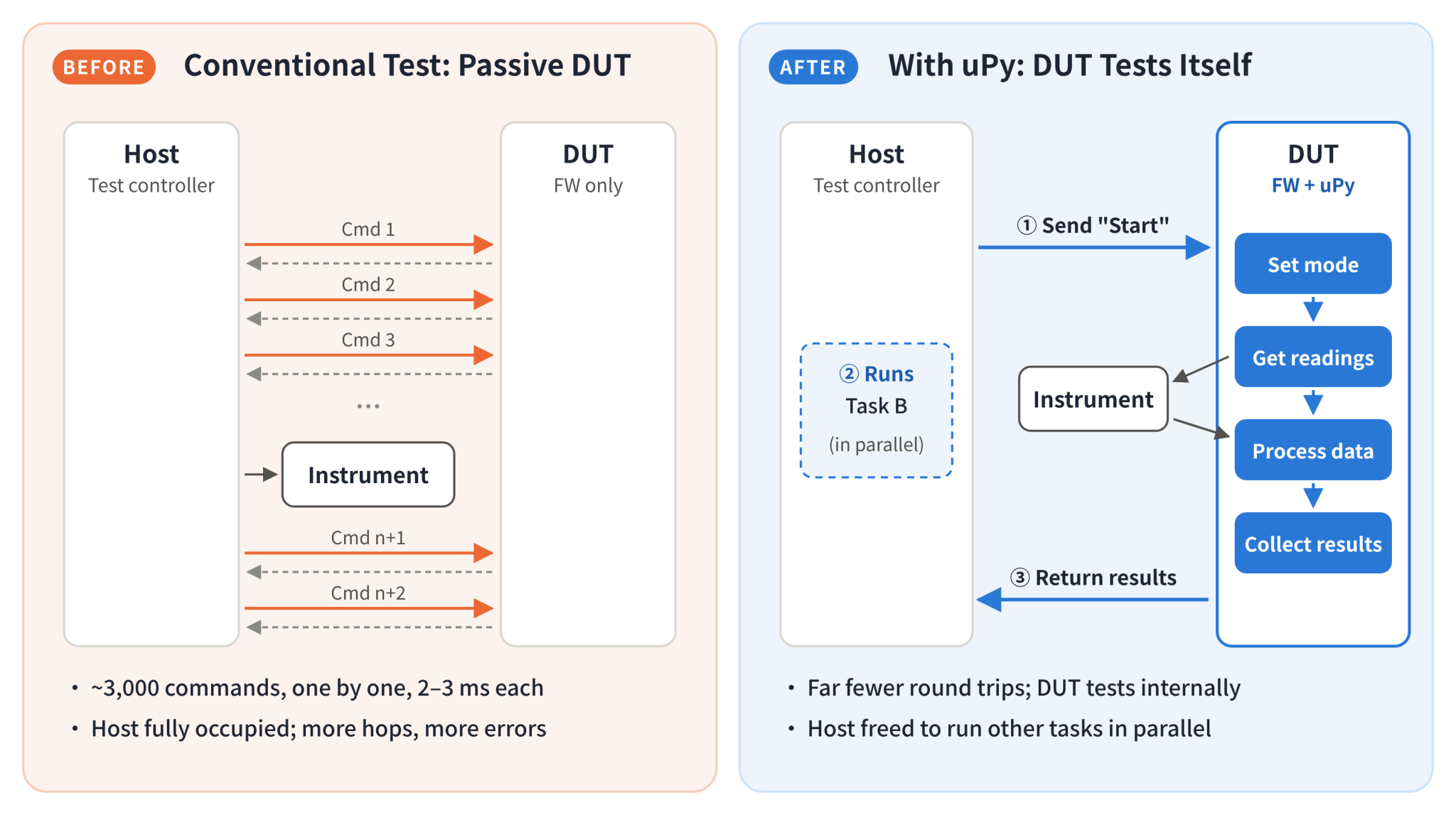
Figure 1 | Test flow before and after uPy. With uPy, the DUT completes testing internally while the host handles other tasks in parallel.
From Concept to Mass Production: Three Hurdles USI Cleared
The team went through two generations of architecture. In the first, the host still could not be fully released during execution; only in the second, where the DUT processes data and runs algorithms on its own, was the host truly freed. Along the way, the team had to clear three hurdles:
1. How should the tasks be divided?
The team classified and prioritized every test item and assessed the DUT’s computing capacity. Reading product information, for example, takes 2–3 ms per command through external diagnostic commands, but only about 2 µs when read internally by uPy, roughly a thousand times faster, with no more dropped characters. Communication is also split by task: I²C for mode setup, UART for command exchange and Ethernet for data acquisition.
2. What if the tools fall short?
MicroPython ships with only a minimal library. Algorithms such as curve fitting and Butterworth filtering, which take a single line to call on the host, had to be developed from first principles in uPy. Because FW and uPy coexist on the same chip, the team also carefully planned the flash memory layout to prevent memory leaks.
3. How should data be exchanged?
To avoid interfering with the FW, uPy uses neither serial-port interrupts nor polling. Instead, a 1 KB scratchpad inside the DUT serves as a “mailbox”: the host writes 0xAA to signal the start; after completing a task segment, the DUT replies “uPy:ok” and writes 0x55 to prompt the next step. Data that must be kept long-term is stored in non-volatile RAM (NVRAM). For floating-point values, which the scratchpad does not support, the team designed a dedicated message format.
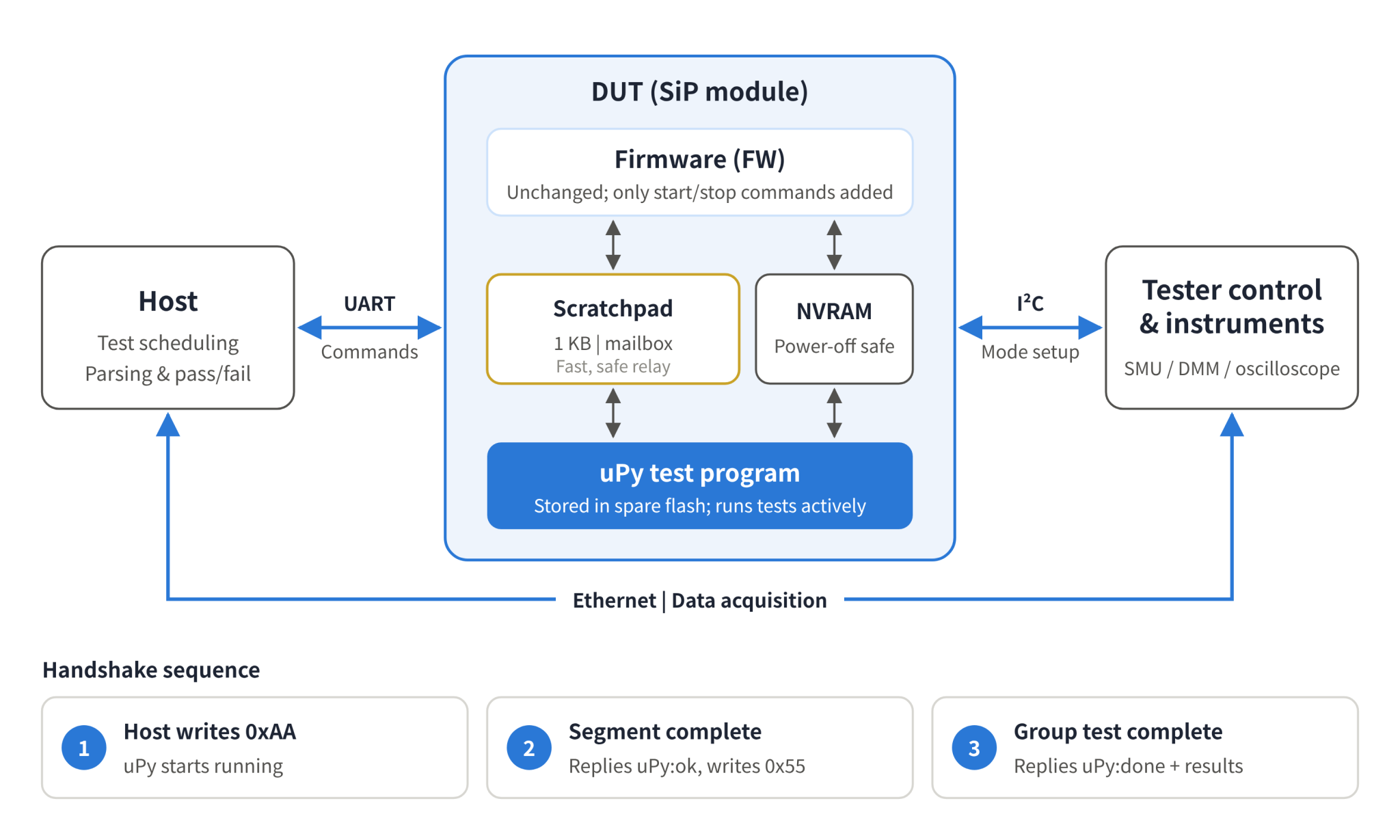
Figure 2 | Communication and data-exchange architecture in uPy mode. FW and uPy exchange data indirectly through the scratchpad and NVRAM.
Results: Per-Unit Test Time Cut from 232.7 s to 163.0 s
On the audio SiP project, uPy cut per-unit test time from 232.7 s to 163.0 s, a saving of 69.7 s, or about 30%, exceeding the original 60-second target. The largest gains came from ADC readout (from 23.7 s to 3.9 s, down 83%) and verification (from 38.2 s to 19.5 s). We also recorded the trade-offs: programming the uPy binary adds 2.2 s and voltage checks take 1.3 s longer, but the net benefit far outweighs these costs.
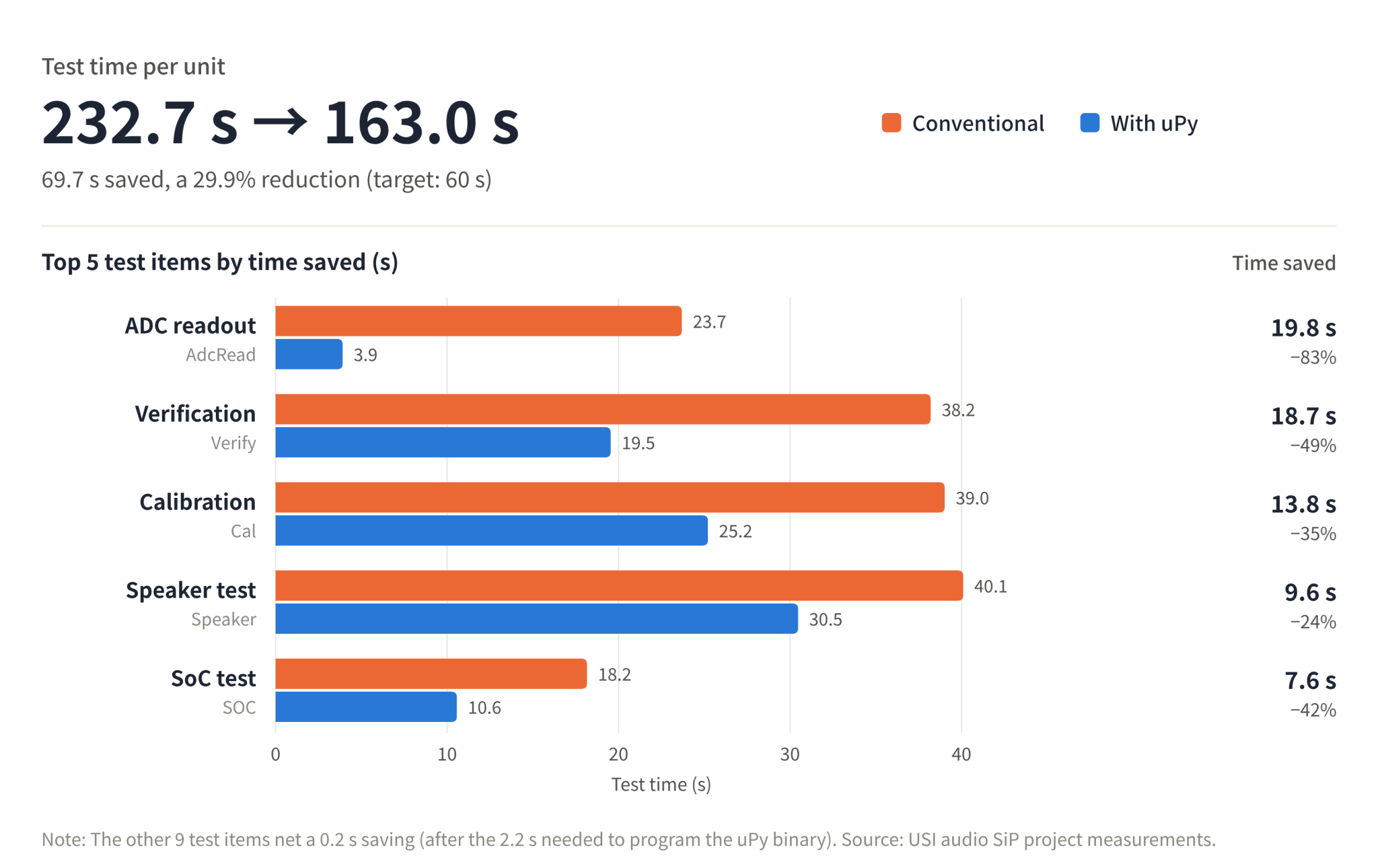
Figure 3 | Test time before and after uPy on the audio SiP project (Source: USI measurements).
What these numbers mean: when the test station is the production bottleneck and all else is equal, each tester can handle about 40% more units per hour; put differently, the same output requires roughly 30% fewer testers. Fewer communication hops also lower the retest rate, while MicroPython’s built-in interactive REPL lets engineers debug in real time.
Beyond Manufacturing: Designing the Test Architecture
This test research project reflects USI’s position in the SiP supply chain: we not only design and manufacture modules but also develop our own test systems, test software and system-level test (SLT) automation frameworks, working with customers at the architecture level to find room for cost reduction. The method adds no product hardware cost and leaves the test software hierarchy unchanged, so any SiP product with a built-in MCU, from smartwatches and earbuds to IoT modules, is a candidate.
Looking ahead, SiPs will only integrate more functions, and the pressure on test time will keep rising. We believe that “letting products take part in their own testing” will evolve from a single-project optimization into mainstream thinking in SiP test design. For USI, every second saved builds long-term competitiveness for our customers.
Frequently Asked Questions
Q1. What is uPy (MicroPython)?
uPy, or MicroPython, is a lean implementation of the Python 3 programming language designed for microcontroller units (MCUs) with limited memory and computing resources. It retains most of Python’s syntax and part of its standard library, and provides an interactive REPL. It is widely used for embedded development in IoT, wearables, automotive and medical electronics. USI applies it to SiP mass-production testing, enabling the device under test to execute test tasks on its own.
Q2. How does uPy shorten SiP test time?
In conventional testing, the host sends commands to the device under test (DUT) one at a time and waits for each reply, about 3,000 command round trips per test. USI writes the interaction-heavy test steps in uPy and programs them into the DUT. During testing, the DUT sets its own modes, triggers instrument measurements and processes the data, sharply reducing communication round trips. Meanwhile, the host can handle other tasks in parallel, so overall test time drops significantly.
Q3. What results has USI achieved with uPy-based testing?
On the audio SiP project for a flagship true wireless stereo (TWS) earbud, per-unit test time fell from 232.7 s to 163.0 s, a saving of 69.7 s, or about 30%, exceeding the original 60-second target. ADC readout dropped from 23.7 s to 3.9 s (down 83%), and verification from 38.2 s to 19.5 s.
Q4. What is SiP (system-in-package), and why does test time matter so much?
SiP integrates multiple chips, such as processors, memory, power management and RF devices, together with passive components into a single packaged module. It is widely used in smartphones, TWS earbuds and smartwatches. Because SiPs are highly integrated and involve many test items, test time directly determines how many testers a production line needs, and therefore its cost. Yole Group projects that the global SiP market will reach US$33.8 billion by 2028, making test efficiency a key competitive advantage in the SiP supply chain.
Q5. Which products are suited to uPy-based testing, and what are the limitations?
uPy-based testing suits SiP products that have a built-in microcontroller (MCU) and spare flash memory, such as TWS earbuds, smartwatches and IoT modules. The limitations: MicroPython’s library is minimal, so algorithms such as filtering and curve fitting must be developed in-house; memory must be carefully planned when uPy coexists with the firmware; and data exchange is constrained by the scratchpad’s capacity (about 1 KB) and supported data types, which calls for a dedicated message format.
Q6. What does a 30% cut in test time mean for customers and EMS production lines?
When the test station is the production bottleneck and all else is equal, a roughly 30% reduction in test time means each tester can handle about 43% more units per hour, or the same output can be achieved with about 30% fewer testers, lowering equipment investment, floor space and operating costs. Fewer communication hops also help reduce the retest rate and improve test reliability.
Search
Recent Articles
-
A New Test Solution for HI Bottleneck: MicroPython Moves SiP from Being Tested to Testing Itself
 A New Test Solution for HI Bottleneck: MicroPython Moves SiP from Being Tested to Testing Itself
10/27/2026
-
From Untestable to Precisely Tested: Cracking the High-Density ICT Challenge
 From Untestable to Precisely Tested: Cracking the High-Density ICT Challenge
10/16/2026
-
Inside 1.6T Optical Transceivers: How Optical Simulation and Coupling Shape Performance and Yield
 Inside 1.6T Optical Transceivers: How Optical Simulation and Coupling Shape Performance and Yield
09/21/2026
-
The Next Frontier in AI Computing: Design and Manufacturing of 1.6T Optical Transceiver Modules
 The Next Frontier in AI Computing: Design and Manufacturing of 1.6T Optical Transceiver Modules
09/07/2026
-
A Key Step in Further Wearable Miniaturization: Selective Encapsulation with Fence + VPE
 A Key Step in Further Wearable Miniaturization: Selective Encapsulation with Fence + VPE
08/17/2026
-
Enabling AI at Scale: The Rise of Silicon Photonics and Optical Transceiver
 Enabling AI at Scale: The Rise of Silicon Photonics and Optical Transceiver
08/03/2026
-
When AI Learns to “Read”: Using Deep Learning to Tame the False-Alarm Storm on SMT Production Lines
 When AI Learns to “Read”: Using Deep Learning to Tame the False-Alarm Storm on SMT Production Lines
07/13/2026
-
Catching Invisible “Micro-Failures”: Safeguarding SiP Reliability Testing with Daisy Chains
 Catching Invisible “Micro-Failures”: Safeguarding SiP Reliability Testing with Daisy Chains
06/29/2026
-
The Hidden Rival Inside an EV’s Heart: Cracking the Power-Loss Puzzle with “Physical Modeling”
 The Hidden Rival Inside an EV’s Heart: Cracking the Power-Loss Puzzle with “Physical Modeling”
06/17/2026
-
Behind the MFG. | From "Manufacturing" to "Creation" Ep.2: Innovation Built from Zero to One
 Behind the MFG. | From "Manufacturing" to "Creation" Ep.2: Innovation Built from Zero to One
05/28/2026
Keep up with top trending topic
For the latest innovation technology, application
and industry insight.
Subscribe Our Blog
For the latest innovation technology, application
and industry insight.