
USI Blog
Top trending topic for the latest innovation technology, application and industry insight.
Search
- 07/13/2026
When AI Learns to “Read”: Using Deep Learning to Tame the False-Alarm Storm on SMT Production Lines
Authors:Yi-Ming Chang, Ti-Li Lin, Hung-Chun Chi, Huang-Po Ying, and Daniel Tsai, ALCMM/SMD Smart Manufacturing Development Center
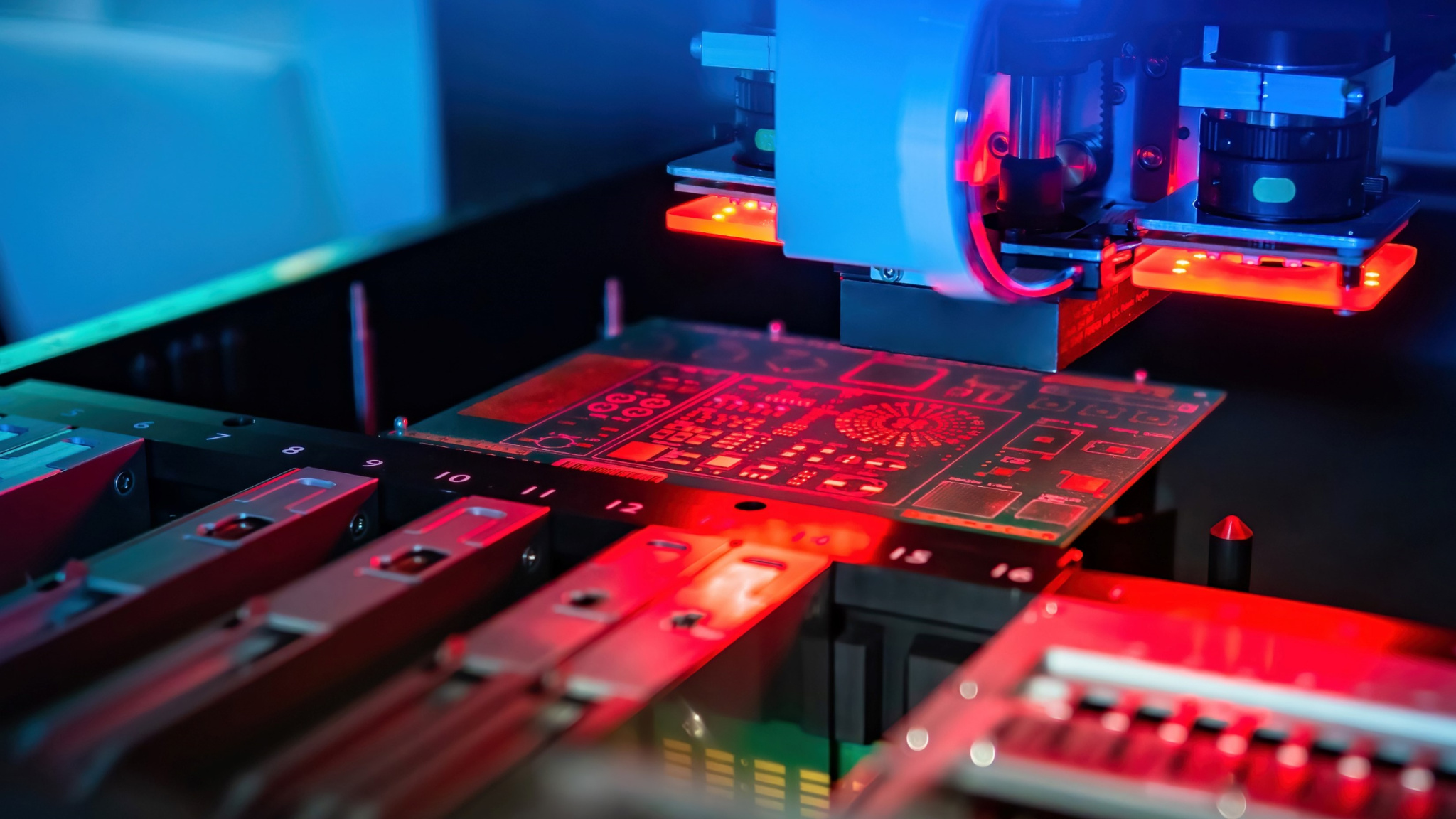
In the world of electronics manufacturing, a certain kind of “false alarm” occurs every day. A seemingly flawless circuit board is flagged by a machine as “potentially defective.” An operator stops working, zooms in on the screen, and inspects it carefully, only to find that nothing is wrong. On an SMT (surface-mount technology) production line, this scenario may happen thousands or even tens of thousands of times a day.
USI’s smart manufacturing team decided to confront this long-standing problem head-on. We developed an innovative architecture that combines deep learning with similarity matching, enabling automated optical inspection (AOI) systems to truly “understand” the text printed on components. The solution delivers an average 90% reduction in false alarms while safeguarding the manufacturing industry’s most critical bottom line: zero escapes.
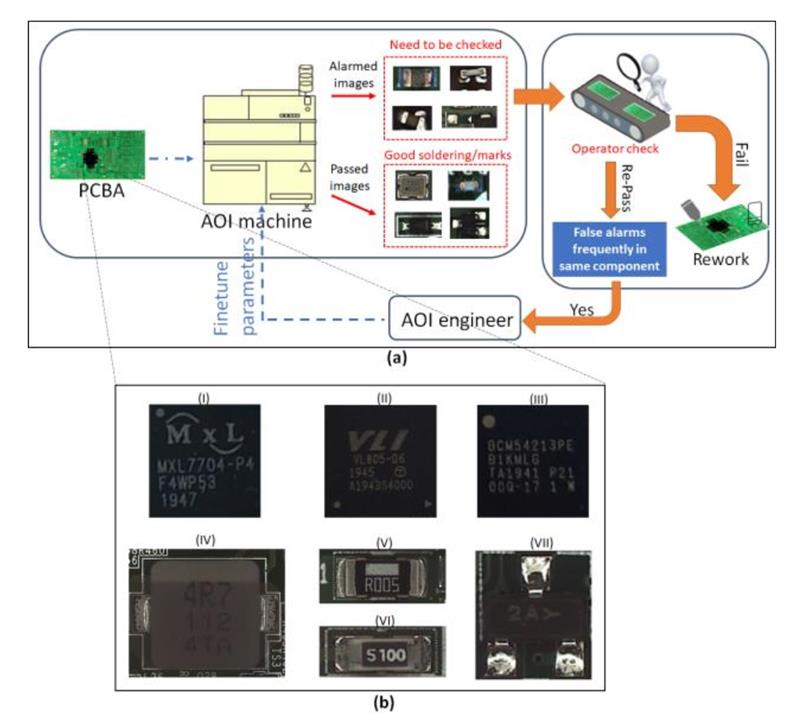
Fig.1 | AOI system workflow (a) and the diversity of component markings (b). Every flagged image requires manual reinspection, making false alarms a hidden drain on production-line efficiency.
Pain-Point Analysis: A Production Line Held Hostage by False Alarms
AOI has become indispensable on SMT production lines because of its high reliability, ease of operation, and low cost. Its operating logic is straightforward: engineers first establish a set of “golden samples” as reference answers for each inspection item. The machine then calculates the similarity between the image under inspection and the golden samples, triggering an alarm when the score falls below the threshold.
The problem is that this similarity-matching approach is excessively sensitive to changes in lighting, color, and position. For the same component, a different illumination angle, a slight shift in the printed characters, or a minor color variation can cause the similarity score to plummet. The machine consequently generates frequent false positives, creating a flood of “cry wolf” alarms.
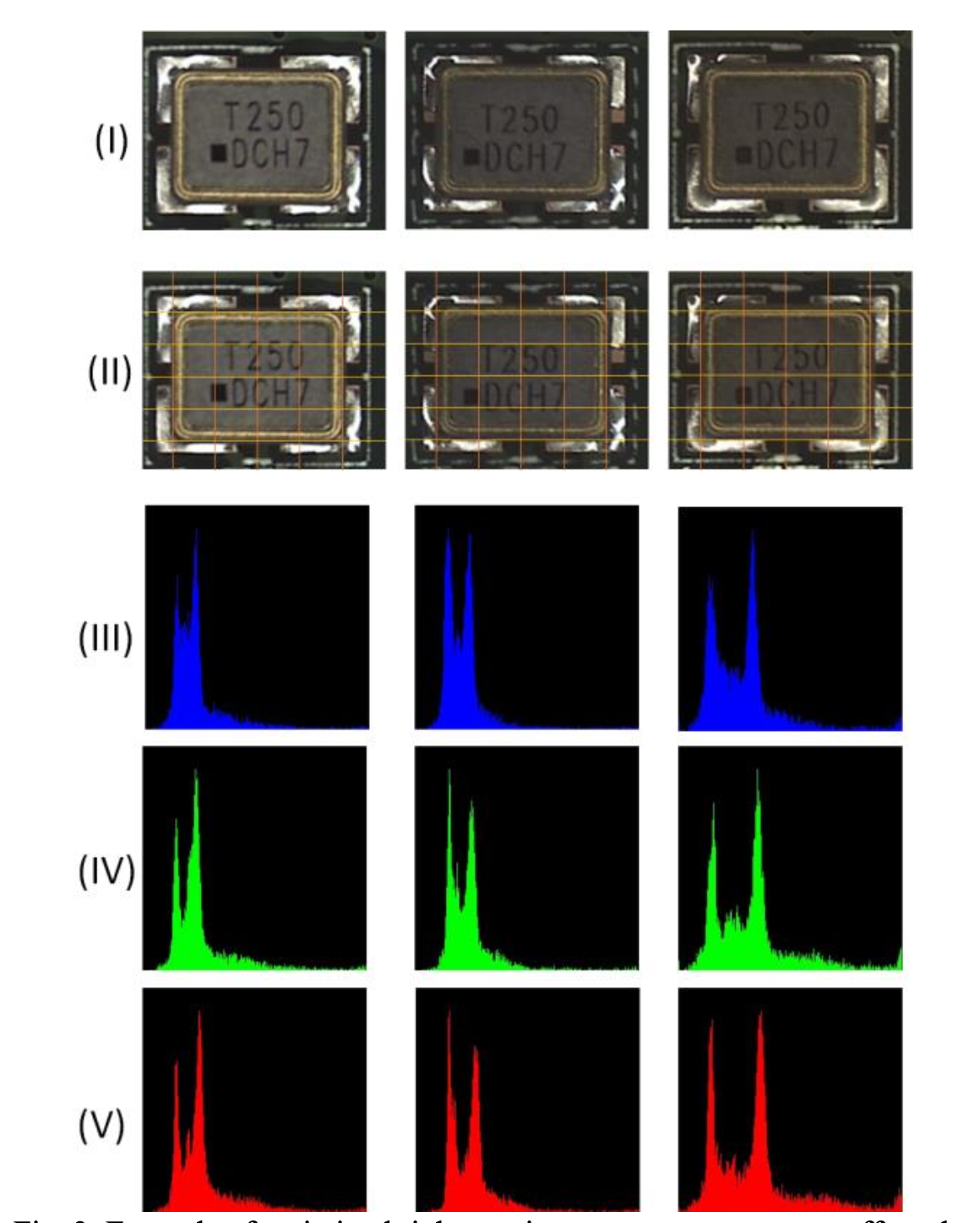
Fig.2 | To the human eye, models (T250DCH7) are the same component; to a conventional similarity algorithm, however, they appear to be “completely different” images.
More specifically, before the new solution was introduced, production lines were constrained by three major issues:
- False alarms undermine efficiency: Many images flagged as “potential defects” are actually good units, yet operators must inspect them one by one. This causes visual fatigue and reduces overall equipment effectiveness (OEE).
- Golden samples are difficult to maintain: A single inspection item may require 30 to 80 golden samples to cover its full range of variation. In a high-mix, low-volume production environment with frequent line changeovers, there is simply not enough time to collect them.
- OCR cannot solve the problem either: Logos, inconsistent character lengths, varied fonts, and special symbols on components all interfere with optical character recognition. Some components even contain characters in different orientations on the same line, which conventional OCR struggles to handle.
The Solution: Enabling AI to Both Recognize and Match
The core concept proposed by the USI team is to avoid relying on a single safeguard. We retained the similarity-matching logic of conventional AOI and added the powerful feature-extraction capabilities of deep learning, creating a “dual-verification” architecture.
Lightweight MobileNet, Built for the Production Line
To meet production-line requirements for low latency, low power consumption, and rapid training, we selected the lightweight MobileNet as the foundation. Its compact architecture allows a single GPU to run multiple models simultaneously and accommodate diverse products and components. The team further modified the end of the model by adding two fully connected layers (FCLs): one outputs the classification result—identifying the component category—while the other is extracted as a “feature vector” for subsequent similarity calculations.
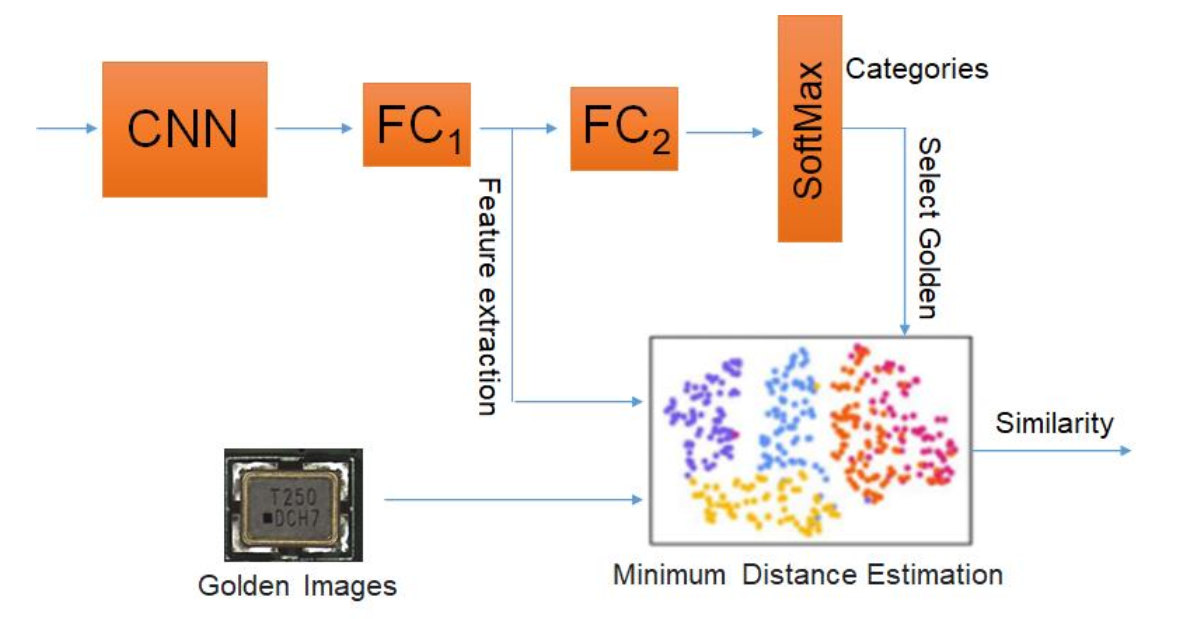
Fig.3 | Architecture of the proposed solution. After an image passes through the CNN and two fully connected layers, the component is classified as good only when both checks are passed.
Dual-Verification Mechanism: The Core of the Solution
This is the solution’s most important innovation. Instead of relying solely on the deep-learning classification result—the main cause of escapes in conventional CNN approaches—the system requires two conditions to be satisfied simultaneously. Only when both conditions are met is the component classified as good. This design effectively prevents the model from mistaking an unseen incorrect marking for the correct category, reducing the escape rate to nearly zero:
- Condition 1 | Correct classification: The model first predicts the component category.
- Condition 2 | Similarity threshold met: The feature vector is then compared with the golden samples. The degree of matching is calculated using minimum-distance estimation and must exceed a defined threshold, such as 0.9.
Using Transfer Learning to Overcome Data Scarcity
High-mix, low-volume production makes it difficult to accumulate a large number of training images within a short period. We therefore use transfer learning: the weights of the pretrained CNN are frozen, and only the newly added fully connected layers are updated. This allows the model to converge quickly and retain strong generalization performance even with limited samples, greatly shortening training and deployment time. In addition, the four possible component orientations—up, down, left, and right, reflecting electronic polarity—are treated as separate classes during training. An additional “Other” class is also included to intercept incorrect markings and further strengthen model robustness.
How Does the New Method Differ from the Old One?
| Dimension | The Old Way | USI's New Approach |
|---|---|---|
| Interference Resistance |
Relies on pixel/feature matching and is extremely sensitive. Changes in brightness, character position, or color can cause the similarity score to plunge, resulting in good units being rejected and false alarms proliferating. | Deep-learning feature extraction plus dual verification. MobileNet extracts deep features and adapts effectively to changes in brightness and position, significantly reducing false alarms and minimizing sensitivity to lighting variations. |
| Training and Setup Efficiency |
Time-consuming manual parameter tuning. Each new component requires the manual collection of 30–80 golden samples and repeated fine-tuning, making it difficult to accommodate frequent line changeovers. | Transfer learning plus automatic feature extraction. The model can be trained with only a small number of samples, while the system learns features automatically. Training is simple and fast, enabling rapid deployment. |
| Quality Risk (Escape Rate) |
Relaxing standards to reduce false alarms—or using an algorithm unable to distinguish highly similar incorrect markings—can lead to escapes. Defective units may enter downstream processes and cause costly repairs or circuit failure. | A similarity threshold serves as a second line of defense. Even if classification is incorrect, anomalous images can still be intercepted. Testing has demonstrated zero escapes, ensuring absolute process quality. |
Beyond Theory: Proven Results on Real Production Lines
- False alarms reduced substantially (90%): Compared with conventional AOI, the solution achieves an average 90% reduction in false alarms across USI factories, greatly decreasing the number of images that operators must reinspect manually. For certain components, such as T250DCH7, the improvement rate reaches as high as 92%.
- Zero escapes achieved: With approximately 25,000 training images and extensive blind testing, the system achieved a 0% escape rate across all test scenarios, including mixed-material tests involving unknown incorrect markings. By comparison, the unmodified MobileNet produced as many as eight escapes in certain tests.
- Unknown incorrect materials successfully intercepted: In simulated wrong-component loading experiments, the system correctly identified every incorrect component—either assigning it to the “Other” class or triggering an alarm because of insufficient similarity. This completely avoids the risk inherent in conventional deep-learning models of treating unknown materials as good units.
More importantly, this method has already been deployed on actual production lines. Because the model is easy to train and quick to deploy, it is not merely an academic result; it is a practical tool that protects quality every day in USI factories. It now delivers significant value directly to our customers:
- Quality assurance and traceability: By accurately identifying component markings, we can ensure that only the correct components are assembled into customers’ products. This also strengthens supply-chain traceability, which is essential in safety-critical industries such as automotive and medical electronics.
- Higher production efficiency and lower costs: The dramatic reduction in false alarms decreases production-line downtime for manual confirmation, directly improving yield and lowering manufacturing costs.
- Faster new product introduction (NPI): The AI model has strong generalization capabilities. When customers launch new products that use new components, the model typically requires only a small amount of data for fine-tuning before it can quickly adapt to recognizing those components. This significantly shortens the time from product development to mass production.
Redefining “Trust” in Manufacturing Processes with AI
For USI, the significance of this technology extends far beyond “reducing the number of alarms.” In an era when customers increasingly require high-mix, low-volume production and product iterations move at unprecedented speed, we embed smart manufacturing capabilities into every stage of the process. AOI evolves from a “noisy alarm” into a quality partner that can “understand what it sees and make accurate judgments.” At the heart of this technology is a dual-verification architecture combining classification and similarity matching, delivering a 90% reduction in false alarms and “zero escapes.”
This represents three things: for customers, more stable yields and shorter introduction times; for supply-chain partners, a more reliable quality commitment and lower hidden risks; and for USI, stronger manufacturing competitiveness built on AI and deep learning. When “zero escapes” changes from a slogan into a measurable fact, USI fulfills its role in the global electronics manufacturing supply chain as a critical partner worthy of trust.
Frequently Asked Questions (Q&A)
Q: What is an AOI system, and how is it used in the SMT process?
A: AOI (automated optical inspection) is a system that automatically inspects circuit-board quality through image recognition. In the SMT (surface-mount technology) process, it rapidly checks solder joints, component positions, and component markings for correctness. Because of its high reliability, ease of operation, and low cost, AOI has become an indispensable quality-control tool on production lines.
Q: Why does conventional AOI generate so many false alarms?
A: Conventional AOI relies on similarity matching to distinguish good units from defective ones, and this approach is highly sensitive to changes in brightness, color, and position. Even for the same component, different lighting, a slight character shift, or a small color variation can cause the similarity score to drop sharply, leading to a false rejection. The resulting flood of false alarms forces operators to spend substantial time on manual reinspection.
Q: What is the core innovation of USI’s deep-learning AOI solution?
A: The core innovation is the dual-verification mechanism. The system requires two conditions to be met: the deep-learning model must produce the correct classification, and the similarity between the feature vector and the golden samples must exceed a threshold, such as 0.9. A component is classified as good only when both checks are passed. This effectively prevents the model from mistaking an unseen incorrect marking for the correct component and reduces the escape rate to nearly zero.
Q: What is an “escape,” and why is it more dangerous than a false alarm?
A: An escape, also known as underkill, occurs when AOI incorrectly classifies a defective product as good and allows it to pass. It is more dangerous than a false alarm because once a defective unit enters the next stage, it may cause irreversible circuit failure, generate costly repairs, or even compromise the safety of the final product. USI’s solution uses a similarity threshold as a second line of defense, and testing has demonstrated zero escapes.
Q: Why not simply use OCR (optical character recognition) to read the text on components?
A: OCR performs poorly in SMT component inspection. Logos, inconsistent character lengths, varied fonts, and special symbols on components can all interfere with recognition. Some components even contain characters in different orientations on the same line, which conventional OCR cannot handle effectively. USI therefore uses an architecture that combines deep-learning feature extraction with similarity matching.
Q: How does transfer learning address the shortage of training data?
A: In high-mix, low-volume production, it is difficult to accumulate a large number of training images quickly. Transfer learning freezes the weights of the pretrained CNN and updates only the newly added fully connected layers. This enables the model to converge rapidly and maintain strong generalization performance with limited samples, greatly reducing training and deployment time.
Q: What value does this technology create for USI’s customers and supply-chain partners?
A: For customers, it provides more stable yields and shorter introduction times. For supply-chain partners, it offers a more reliable quality commitment and lower hidden risks. For USI, it strengthens smart manufacturing competitiveness centered on AI and deep learning. The solution has already been deployed on actual production lines, where it safeguards SMT process quality every day.
Search
Recent Articles
-
From Untestable to Precisely Tested: Cracking the High-Density ICT Challenge
 From Untestable to Precisely Tested: Cracking the High-Density ICT Challenge
10/16/2026
From Untestable to Precisely Tested: Cracking the High-Density ICT Challenge
10/16/2026
-
Inside 1.6T Optical Transceivers: How Optical Simulation and Coupling Shape Performance and Yield
 Inside 1.6T Optical Transceivers: How Optical Simulation and Coupling Shape Performance and Yield
09/21/2026
Inside 1.6T Optical Transceivers: How Optical Simulation and Coupling Shape Performance and Yield
09/21/2026
-
The Next Frontier in AI Computing: Design and Manufacturing of 1.6T Optical Transceiver Modules
 The Next Frontier in AI Computing: Design and Manufacturing of 1.6T Optical Transceiver Modules
09/07/2026
The Next Frontier in AI Computing: Design and Manufacturing of 1.6T Optical Transceiver Modules
09/07/2026
-
A Key Step in Further Wearable Miniaturization: Selective Encapsulation with Fence + VPE
 A Key Step in Further Wearable Miniaturization: Selective Encapsulation with Fence + VPE
08/17/2026
A Key Step in Further Wearable Miniaturization: Selective Encapsulation with Fence + VPE
08/17/2026
-
Enabling AI at Scale: The Rise of Silicon Photonics and Optical Transceiver
 Enabling AI at Scale: The Rise of Silicon Photonics and Optical Transceiver
08/03/2026
Enabling AI at Scale: The Rise of Silicon Photonics and Optical Transceiver
08/03/2026
-
When AI Learns to “Read”: Using Deep Learning to Tame the False-Alarm Storm on SMT Production Lines
 When AI Learns to “Read”: Using Deep Learning to Tame the False-Alarm Storm on SMT Production Lines
07/13/2026
When AI Learns to “Read”: Using Deep Learning to Tame the False-Alarm Storm on SMT Production Lines
07/13/2026
-
Catching Invisible “Micro-Failures”: Safeguarding SiP Reliability Testing with Daisy Chains
 Catching Invisible “Micro-Failures”: Safeguarding SiP Reliability Testing with Daisy Chains
06/29/2026
Catching Invisible “Micro-Failures”: Safeguarding SiP Reliability Testing with Daisy Chains
06/29/2026
-
The Hidden Rival Inside an EV’s Heart: Cracking the Power-Loss Puzzle with “Physical Modeling”
 The Hidden Rival Inside an EV’s Heart: Cracking the Power-Loss Puzzle with “Physical Modeling”
06/17/2026
The Hidden Rival Inside an EV’s Heart: Cracking the Power-Loss Puzzle with “Physical Modeling”
06/17/2026
-
Behind the MFG. | From "Manufacturing" to "Creation" Ep.2: Innovation Built from Zero to One
 Behind the MFG. | From "Manufacturing" to "Creation" Ep.2: Innovation Built from Zero to One
05/28/2026
Behind the MFG. | From "Manufacturing" to "Creation" Ep.2: Innovation Built from Zero to One
05/28/2026
-
Behind the MFG. | From "Manufacturing" to "Creation" Ep.1: Unveiling USI’s Technological Vanguard
 Behind the MFG. | From "Manufacturing" to "Creation" Ep.1: Unveiling USI’s Technological Vanguard
05/07/2026
Behind the MFG. | From "Manufacturing" to "Creation" Ep.1: Unveiling USI’s Technological Vanguard
05/07/2026
Keep up with top trending topic
For the latest innovation technology, application
and industry insight.
Subscribe Our Blog
For the latest innovation technology, application
and industry insight.